


 English
  русский
  Français
  Español
  عربى
عربى Corrugated Box Standards Explained: ECT, Burst Test, FEFCO Codes & BMC Guide
Aug 28, 2026
Content
Two quotes land on your desk for what looks like the same brown shipping box. One is built on 200# burst board, the other on 32 ECT, and the prices differ by a double-digit percentage. Both suppliers call their board the standard choice, and nothing in the quotes tells you who is right. This is precisely the situation corrugated box standards exist to settle.
The short answer: ECT ratings predict how well a box stacks, Mullen burst ratings predict how it survives punctures and rough handling, FEFCO codes define a box's shape, and the Box Manufacturer's Certificate (BMC) turns all of it into a verifiable claim. Once you can read these four pieces, you can judge any quote in minutes and buy the strength you actually need. The sections below explain where each number comes from and how to write it into an order.
Two Ratings Decide Most Quotes: ECT and the Mullen Burst Test
The Edge Crush Test (ECT) compresses a small column of combined board on its edge until the fluted core buckles. A board rated 32 ECT resists 32 pounds of force per inch of width before that column collapses. Because stacked boxes almost always fail this way, with walls bowing under the weight above them, ECT is the best single predictor of pallet and warehouse performance, and the first number e-commerce buyers should check. Our guide to what a 32 ECT box actually means breaks the rating down step by step.
The Mullen burst test measures something else: the hydraulic pressure needed to rupture the linerboard, reported as 200#, 275# or 350# test board. Burst strength tracks resistance to punctures, tears and rough sorting-hub treatment, which is why it governed freight packaging for most of the twentieth century.
The catch is that 200# burst and 32 ECT are often called equivalent. For single-wall C-flute boxes they perform similarly in many uses, but the tests measure different failure modes, so a design can pass one while failing the other. A pallet of bottled sauce stored four-high stresses the board's columns, which is ECT territory. A carton of machine parts bounced through three couriers stresses the liner's surface, which is burst territory. Match the rating to the failure you most need to avoid.
| Attribute | Edge Crush Test (ECT) | Mullen Burst Test |
|---|---|---|
| What it measures | Compression resistance of the board's edge columns | Pressure needed to rupture the linerboard |
| Common methods | ASTM D2041, ISO 3037, TAPPI T 811 | ASTM D774, ISO 2758, TAPPI T 810 |
| Typical ratings | 23, 32, 40, 44, 48, 55 ECT | 125#, 200#, 275#, 350# |
| Predicts best | Stacking strength on pallets and in storage | Puncture and tear resistance in transit |
| Typical fit | Parcel e-commerce and retail-ready loads | Heavy, sharp-edged or concentrated loads |
For most online sellers, the practical starting point is a single-wall C-flute cube box in the 32 ECT range, strong enough for a stacked shelf inside a delivery van yet light enough to keep dimensional-weight charges down.
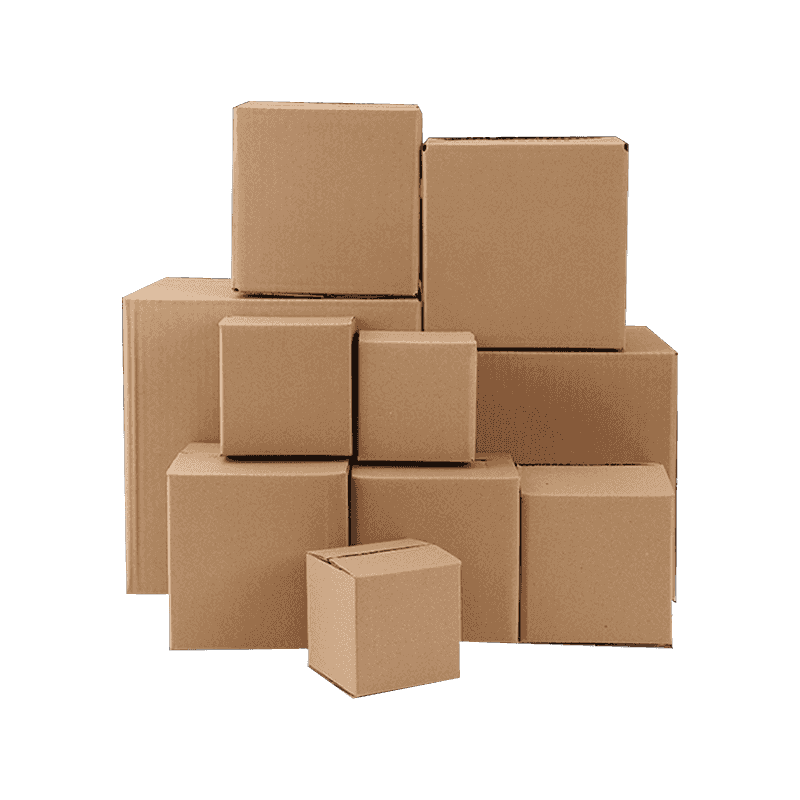 Standard Cube Corrugated Shipping BoxesSingle-wall C-flute cube boxes in the 32 ECT range offer a practical starting point for e-commerce shipping, stacking tightly on pallets while keeping dimensional-weight charges low.View Product →
That is the class of board behind our standard cube corrugated shipping boxes, and it is where most e-commerce specifications should begin before being tuned up or down.
Construction Standards: Flute Profiles and Wall Counts
Strength ratings only make sense next to construction, because the same rating can be reached through different flute and liner combinations. Board is named by its flute profile, meaning the height and spacing of the wavy medium glued between the liners.
- A flute (about 4.8 mm): the most cushioning; suits fragile glassware and produce.
- C flute (about 4.0 mm): the shipping-box default, balancing stacking strength with print surface.
- B flute (about 3.0 mm): stiffer to bend; common in canned-goods trays and die-cut mailers.
- E flute (about 1.5 mm): a smooth face for quality printing; typical of cosmetic and retail packaging.
- F flute (about 0.8 mm): finer still, for a folding-carton look with corrugated strength behind it.
Wall count multiplies the options. Single-wall board, one fluted medium between two liners, covers most parcel work. Double-wall board, usually a BC or AC combination, adds a second flute layer for heavier goods, longer routes and higher stacks. Triple-wall board approaches the performance of a wooden crate for industrial freight. Heavy electronics fit the middle category: our LCD display packaging boxes are built on double-wall board so the panel survives both compression and impact in transit.
 Corrugated LCD Display Packaging BoxesBuilt on double-wall board, these boxes add the second flute layer needed for heavy electronics, protecting LCD panels against compression and impact over longer routes and higher stacks.View Product →
One variable no certificate captures is climate. Board is conditioned before testing at roughly 23°C and 50% relative humidity, but move the same box into a monsoon-season warehouse and stacking strength can fall steeply, with losses near half commonly reported at very high humidity. Buyers serving tropical markets should build in an ECT margin rather than trusting a dry-laboratory number alone.
The Box Manufacturer's Certificate: The Stamp Behind the Claim
Turn over most corrugated boxes sold in the United States and you will find a printed stamp on the bottom flap: the Box Manufacturer's Certificate. It states the manufacturer and plant location, the board class such as "singlewall, C flute," the certified strength rating, and the maximum size and gross weight limits the box was built to carry.
Its value is accountability. When a damage claim or freight dispute arises, the certificate is the reference for what the box was guaranteed to do. Buyers sourcing overseas should treat it as a checklist item: ask whether your boxes will carry a certificate matching the destination market's requirements, and request the underlying test report so the stamped numbers trace back to a laboratory result.
The Standard Families Buyers Actually Encounter
A handful of organizations produce nearly every number you will see on a quote:
- ASTM (US): D2041 covers ECT, D774 the burst test, D642 compression resistance of a filled finished box, and D1974 closing and sealing.
- ISO and TAPPI: ISO 3037 and TAPPI T 811 describe ECT, ISO 2758 and TAPPI T 810 cover burst, and ISO 12048 defines stacking and compression tests on complete filled packages.
- FEFCO (Europe): known for the international case codes, where 0201 is the regular slotted container most people picture as "a cardboard box," plus a Good Manufacturing Practice standard and recyclability design guidelines.
- GB/T (China): transport boxes are commonly ordered to GB/T 6543, with board specifications under GB/T 6544.
The test methods align closely across these families, but report formats do not. When a supplier says "32 ECT," ask which method the report cites and request the full sheet. A factory that runs its own corrugator, rather than buying board from a third party, can usually generate these documents from in-house testing, which shortens the loop whenever a specification needs adjusting.
Writing the Standards into a Purchase Order
Specifications only become useful once they are written down. An order that says "strong brown box" invites the supplier to guess; one that names the standard removes the guesswork. A workable sequence looks like this:
- Define the load: product weight, boxes per pallet, stacking height and expected storage time.
- Choose the rating that matches the dominant risk, ECT for stacked storage or burst for rough handling, or ask the supplier's packaging engineer to recommend one and explain why.
- Specify geometry with a code, for example "FEFCO 0201, single-wall C flute," rather than a photograph.
- Require documentation: a test report citing the method used, plus an ISTA transit test for international lanes.
- Agree on conditioning and tolerances, including a dimensional tolerance such as ±3 mm and the humidity the boxes will face in transit and storage.
Two procurement mistakes appear again and again. The first is over-specifying: moving from 32 ECT to 44 ECT "to be safe" raises material cost and freight weight on every unit, buying strength most parcel loads never use. The second is treating equivalent ratings as identical, since 200# burst and 32 ECT fail differently, so any swap should be validated against the real load.
Sellers with a wide catalog face one more choice: standardizing on a few board grades rather than engineering every size separately. A fixed size ladder on one common grade keeps costs predictable, which is how our twelve-size e-commerce shipping box range holds a single board specification across the series while flute and wall stay constant.
12 Size Options E-commerce Cardboard Shipping BoxesA fixed twelve-size ladder on one common board grade keeps flute and wall constant across the series, letting sellers with wide catalogs standardize packaging and hold costs predictable.View Product →Nobody buying boxes needs to memorize test methods. What matters is that the supplier can connect your product's real risks, from stack height to route handling to destination climate, to the right rating and prove it with documents. That is easier to demand from a manufacturer that makes its own board, where combined board quality is controlled at the corrugator rather than delegated upstream. Zhejiang Wenchen Packaging Technology has run that vertically integrated model since 2004 across plants in Jiaxing and Zhangshu, producing board and boxes under one roof for e-commerce, food, electronics and export customers. Review the full range at Zhejiang Wenchen Packaging, then bring these standards to your next quotation.

- Contact Us
- Phone:+86-138 1869 0662
- TEL:+86-573 8570 0965
- Email:[email protected]
[email protected] - Address:No. 269, Jinsui Road, Xincang Town, Jiaxing City, Zhejiang Province, China
- Get in Touch

